Education In-Plant Leader Hub

Build the answer before anyone asks the question.

The strongest in-plants do more than produce work. They make their value visible before the budget review, the outsourcing proposal, the leadership transition, or the strategic planning conversation puts that value on trial.

That does not happen all at once.

It starts with one conversation your institution is already ready to have. Maybe students are not getting materials in the format they need. Maybe teachers and faculty are still routing around the shop because the workflow feels too hard to use. Maybe advancement, admissions, or athletics is sending high-value work to commercial vendors. Maybe IT, finance, legal, or compliance is already asking questions about data, vendors, devices, and documentation.

You choose the value stream. You baseline the work for 90 days. You translate the numbers into the language your coalition uses. Then you bring the answer into the room before someone else frames the question.

This hub is built for that work.

The arc

What changes when an in-plant proves its value?

Most education in-plants move through a familiar arc.

Level 1
Cost Center
The shop produces work.
Read the full description
People know it exists. Leadership may appreciate it, but the value is mostly assumed. When someone asks whether the operation should be funded, refreshed, expanded, outsourced, or reduced, the shop has to defend itself from a standing start.
Level 2
Consulted
The in-plant leader is brought into some conversations.
Read the full description
A department asks for help. Finance asks about a cost comparison. IT asks about devices. Advancement asks about a campaign. The shop has some data, but the relationships are still mostly transactional.
Level 3
Trusted Producer
Performance is documented and shared.
Read the full description
Department heads have seen the numbers. Finance has seen cost comparisons. Academic leaders know which materials were delivered on time. The shop is trusted because its record is visible.
Level 4
Campus Expert
The in-plant leader is in the room earlier.
Read the full description
Her reporting is part of the institution's rhythm. Leaders understand what the shop contributes to learning, communication, cost control, and governance. The conversation moves from defense to investment.
That is the arc this hub supports: from a shop that processes requests to an operation the institution recognizes as a strategic asset.

The map

The maturity arc — and your four entry points.

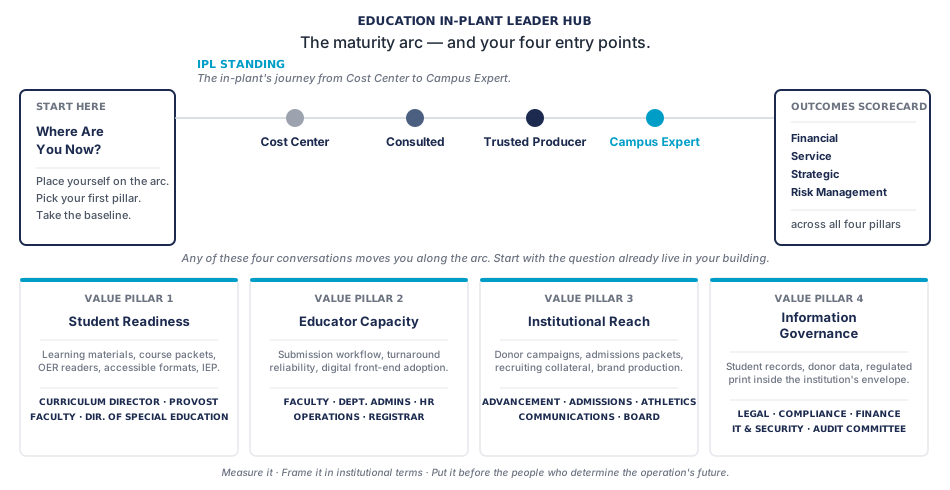
Education In-Plant Leader Hub diagram. The maturity arc runs from Cost Center through Consulted and Trusted Producer to Campus Expert, surrounded by the four playbooks — Student Readiness, Educator Capacity, Institutional Reach, and Information Governance — each with its named coalition. The four Outcomes Scorecard domains (Financial, Service, Strategic, Risk Management) frame the institution-level translation layer.
Any of the four playbooks moves you along the arc. Start with the question already live in your institution.

Where to begin

How do you know where to start?

You do not need to prove everything at once.

The best starting point is usually the question already alive in your institution.

If the academic conversation is already active, begin with the work students and educators touch every day. If the financial conversation is already active, begin with the work leaving the building or sitting across scattered budgets. If the reputation conversation is already active, begin with the materials that shape admissions, advancement, athletics, family engagement, and events. If the governance conversation is already active, begin with data, documentation, vendors, and chain of custody.

One value stream. One coalition. One 90-day baseline. That is enough to begin.

The Outcomes Scorecard

The translation layer between shop performance and institutional value.

The Outcomes Scorecard does not ask the in-plant to measure everything. It asks the in-plant to measure the few things that travel to leadership.

Four domains, four conversations.
Domain What it measures Anchor metric The question it answers
Financial Cost efficiency and cost avoidance compared with commercial alternatives In-plant vs. commercial cost comparison by job type Are we getting good value for what we spend?
Service Production reliability and responsiveness across the academic calendar On-time rate · First-time-right rate Can the shop be counted on when it matters most?
Strategic Contribution to learning, communication, enrollment, advancement, and institutional priorities Satisfaction or outcome reporting by department or value stream Is this operation advancing the institution's priorities?
Risk Management Governance discipline, audit readiness, and data handling in a regulated environment Job documentation completeness and chain-of-custody readiness If something goes wrong, can we answer with records?

Each playbook in this hub deepens one part of the scorecard. Student Readiness strengthens the service and strategic story around student-facing materials. Educator Capacity strengthens the service story around submission workflow and practitioner trust. Institutional Reach strengthens the financial and strategic story around high-value communication. Information Governance strengthens the risk management story around data handling, documentation, and vendor exposure.

One more thing worth naming: the maturity signal isn't only in the scores. It's in the relationships those scores make possible.

The people this scorecard reaches at each stage of the arc aren't internal customers — they're a coalition. Not people you report to, but people you work alongside in service of the institution you share. A Finance Officer who has seen three years of cost comparisons comes to the budget conversation as a partner, not an auditor. A Curriculum Director who receives a quarterly on-time report stops wondering whether the shop can be counted on and starts defending it. A General Counsel who understands how the in-plant handles regulated print data is in the room with you, not across the table from you.

Each pillar playbook in this hub names the coalition specific to that value stream — the people whose questions it answers, whose concerns it anticipates, and whose trust it builds over time. The scorecard is the tool that earns you a seat in those conversations.

Four value streams. One strategic arc.

Your in-plant creates institutional value in four distinct ways.

Each one is a different conversation with a different coalition — and any one of them, pursued with the discipline of the playbook and the rigor of the scorecard, moves you along the arc.

You don't choose based on what's most important in the abstract. You choose based on what question is already live in your institution.

01
Student Readiness
If the live question is whether students are getting the right materials, start here.
For the in-plant leader whose shop is already part of the learning infrastructure. Course readers, assessment booklets, intervention sets, accommodation formats — produced in the right format, on the right timeline, with the documentation the institution needs.
Coalition Curriculum · Faculty · Academic Affairs · Special Education · Library / OER
See the playbook
02
Educator Capacity
If the live question is whether the shop is easy enough to use, start here.
For the in-plant leader who knows the shop may be capable, but also knows capability doesn't matter if teachers, faculty, and departments keep routing around it. Make the supported workflow easier than the workaround.
Coalition Teachers · Faculty · Department Leaders · HR · Operations · Registrar · Internal Communications
See the playbook
03
Institutional Reach
If high-value communication is leaving the building, start here.
For the in-plant leader who can see the institution's outward voice being produced somewhere else. Admit packets, donor pieces, athletic recruiting, brand-consistent campaigns — bring high-value communication back inside.
Coalition Admissions · Advancement · Athletics · Communications · Cabinet · Finance
See the playbook
04
Information Governance
If the live question is data, cost, audit readiness, or vendor exposure, start here.
For the in-plant leader who understands that the shop is already handling institutional data, whether the institution has fully recognized it or not. Make the shop a governance safeguard, not a loose end.
Coalition IT · Finance · Compliance · General Counsel · Risk Management · Audit Leadership
See the playbook

Choose your starting point

Where should you begin?

Start where the institution already feels pressure.

That does not always mean starting where the shop is strongest. It means starting where the institution is most ready to listen.

If the pressure is academic, begin with Student Readiness or Educator Capacity. If the pressure is financial or reputational, begin with Institutional Reach. If the pressure is legal, technical, or audit-driven, begin with Information Governance.

The first 90 days should be focused. Pick one playbook. Choose the coalition. Establish the baseline. Bring back the first report. That report does not need to prove everything. It needs to prove that the in-plant can measure what matters and translate it into language the institution can use.

The first 90 days

What does the first 90 days look like?

01
Choose one value stream.
Do not begin by trying to tell the full in-plant story. Choose the conversation that already has attention inside your institution.
02
Name the coalition.
Identify the people who need the answer: curriculum, finance, admissions, advancement, IT, compliance, or another group depending on the value stream.
03
Pick the anchor metrics.
Choose two or three metrics from the playbook. Start with what you can measure now, even if the first version is imperfect.
04
Build the baseline.
Track the work for 90 days. Focus on the jobs, workflows, costs, or documentation that matter most to the coalition.
05
Translate the result.
Do not bring raw shop data into the room. Translate it into the coalition's question: cost avoided, time returned, risk reduced, materials delivered, vendor spend recovered, or communication produced on the institution's calendar.
06
Hold the first conversation.
Bring the answer to the people who can use it. Then decide what the next 90 days should measure.

Why this matters

An in-plant can be loved and still be vulnerable.

People may appreciate the team. They may know the shop works hard. They may rely on it every week. But appreciation is not the same as documented value.

The in-plant leader's work is to make value visible before it has to be defended.

That does not mean turning every conversation into a spreadsheet. It means connecting the work of the shop to the outcomes the institution already cares about: students prepared, educators supported, communications delivered, costs explained, data handled responsibly.

When that connection is visible, the shop stops being a line item that needs defending. It becomes an institutional capability worth strengthening.

FAQ

Frequently asked questions about running an education in-plant

By choosing one conversation the institution is already ready to have, baselining the relevant work for 90 days, and translating the results into the language the coalition uses. The four value streams are Student Readiness, Educator Capacity, Institutional Reach, and Information Governance. Each has a playbook, a scorecard subset, and coalition-specific conversation guides.

The translation layer between shop performance and institutional value — organized into four domains: Financial, Service, Strategic, and Risk Management. Each domain answers a different leadership question and reaches a different room.

Cost Center → Consulted → Trusted Producer → Campus Expert.

Start where your institution already feels pressure. Academic pressure → Student Readiness or Educator Capacity. Financial or reputational pressure → Institutional Reach. Legal, technical, or audit pressure → Information Governance.

Start the conversation

No in-plant makes this shift in one move.

The work begins with a single decision: measure what matters, frame it in institutional language, and put it in front of the people who determine the operation's future.

Pick the playbook that matches the pressure your institution already feels. Take the first baseline. Build the first 90 days. Let the credibility compound.